

Antislipverf is een noodzaak!
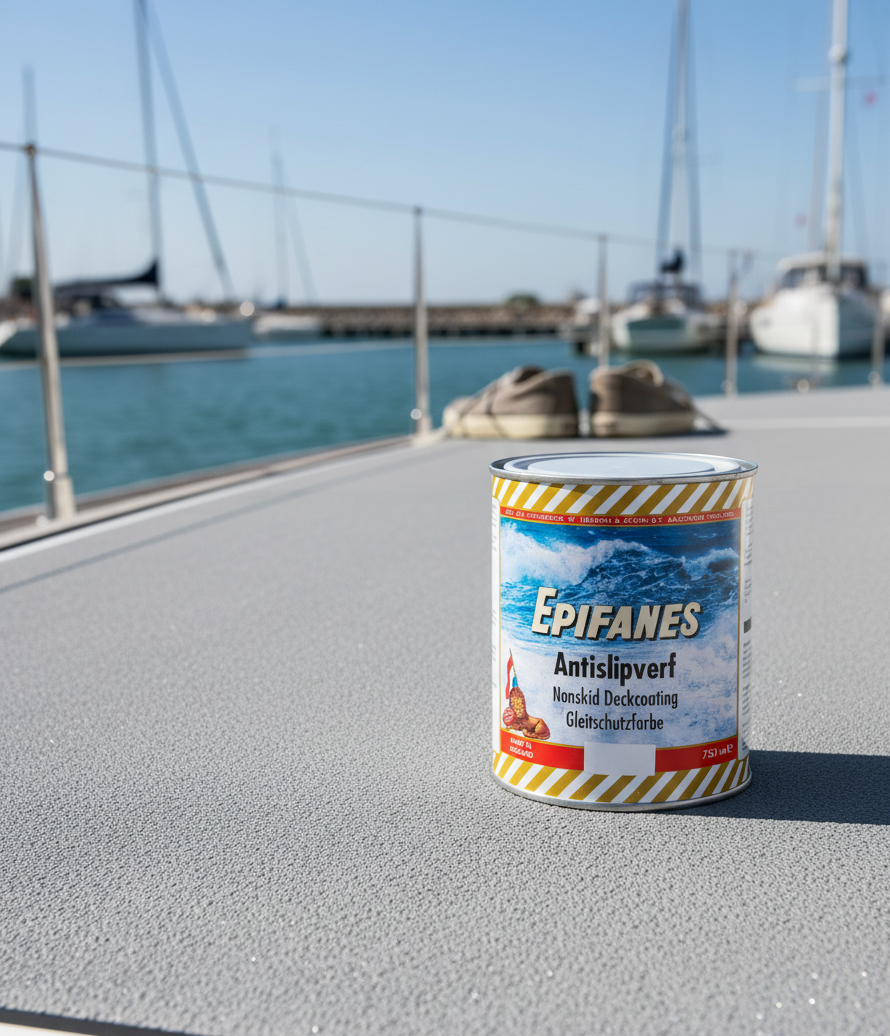
Why Use Non-Slip Paint on a Ship Deck?
The deck of a ship—whether it’s a sailboat, motor yacht, or work vessel—can become slippery and therefore dangerous in wet weather or when water comes on board. Standard paints often provide a relatively smooth surface, and once the deck is wet, slipping can occur. This is particularly unsafe during sudden movements of the vessel or when working on deck.
Non-slip paint creates a rough, textured surface that provides good grip with bare feet or shoes. This helps prevent accidents and increases safety and comfort on board.
Additionally, non-slip paint is wear-resistant and durable against intensive use and exposure to the elements.
In short: non-slip paint is not a luxury, but for a walking deck, it is essentially a necessity in wet conditions or for heavily used decks.
What Exactly Is Non-Slip Paint?
Non-slip paint is “regular” paint that contains granules or agents (non-slip additives) that make the surface uneven. These irregularities create friction under your feet. Concretely, this means the surface is much more slip-resistant, making it safer in wet or damp conditions.
The paint is often slightly harder and more wear-resistant than standard coatings to withstand foot traffic, shoes, and abrasion.
Non-slip paint is therefore intended for “walking decks” — not for walls or decorative parts. It can be applied on various substrates, such as wood, steel, aluminum, polyester (gelcoat), and more.
Below are two very common and proven non-slip paints frequently used in pleasure boating and ship maintenance.
Epifanes Non-Slip Paint
Epifanes Non-Slip Paint is a one-component, urethane/alkyd-based paint with polypropylene granules as the non-slip agent. The granules do not settle and provide solid grip. They are not sharp, so bare feet can comfortably walk on the deck.
Key Features:
-
Suitable for wood, steel, aluminum, and polyester.
-
Available in several standard colors: white, cream #1, grey #212, grey #213.
-
Coverage: 750 ml is typically enough for approximately 3–6 m² at 40 µm dry film thickness.
-
Application: recommended with a short-pile roller (like velour) to evenly distribute the granules. Stir regularly during application to prevent the granules from settling.
-
Recoatable after approximately 24 hours at around 18 °C.
-
Ideally applied in two layers for effective non-slip protection, allowing sufficient drying/cure time before use.
Epifanes emphasizes that the non-slip granules are “lightweight,” meaning the surface provides grip without feeling sharp underfoot, ensuring comfort for pleasure craft use.
International Interdeck Non-Slip Paint
International Interdeck Non-Slip Paint is International’s non-slip deck coating. This polyurethane-based paint contains fine non-slip material, providing a slip-resistant and durable deck finish.
Features:
-
Suitable for various surfaces: aluminum, steel, wood, polyester (gelcoat).
-
Semi-gloss finish — reduces sun reflection (less glare), enhancing comfort.
-
Coverage: approximately 10 m² per liter.
-
Application: easy to apply with a brush or roller; 1–2 coats recommended.
-
Available in different colors: white, cream, grey, sand beige, squall blue, depending on the supplier.
Interdeck is particularly popular for vessels where durability, strength, and a neat finish are important—such as larger yachts or heavily used work decks.
Practical Considerations When Applying Non-Slip Paint
Surface Preparation:
-
Ensure the deck is clean, grease-free, and dust-free. Lightly sand old paint layers (e.g., P180 sandpaper) to improve adhesion.
-
For steel surfaces: remove rust thoroughly (down to bare metal) by sanding or grinding. Reapply primer if needed before applying non-slip paint.
-
For polyester (gelcoat) or wooden decks: cleaning, degreasing, and light sanding may also be necessary.
Proper preparation is essential for durability. Painting on an unprepared, greasy, or rusty surface can cause the non-slip layer to peel or fail to adhere.
Application Method:
-
Use a short-pile roller (velour or similar) for even distribution of non-slip granules.
-
Stir the paint thoroughly before and during application to keep granules evenly suspended.
-
Preferably apply two coats for a durable non-slip surface.
-
Allow the final coat to cure sufficiently before use — 72 hours is commonly recommended to safely bear deck loads.
Maintenance and Use:
-
Non-slip paint is not maintenance-free. With intensive use or heavy loads (e.g., heavy objects, frequent walking, moving equipment), wear may occur, requiring minor repairs or touch-ups.
-
Due to the textured surface, non-slip paint can be slightly harder to clean than smooth coatings—dirt and sand may cling more easily.
-
Regularly inspect the non-slip surface, especially on vessels operating in harsh conditions (saltwater, heavy use, intensive traffic).
Why Epifanes and International Paints Are Often Preferred
-
Both brands are specially developed for boating and maritime use; their formulas are tested for typical onboard conditions, such as saltwater, moisture, foot traffic, and temperature fluctuations.
-
They offer excellent adhesion to various substrates (wood, steel, aluminum, polyester), providing flexibility for boat maintenance and renovation.
-
Their non-slip paints combine slip resistance with comfort: granules or structural additives provide grip without feeling sharp or uncomfortable for bare feet, which is especially important for pleasure craft or yachts.
-
Easy application: both Epifanes and International can be applied with a roller or brush without specialized equipment.

